Leafield C.E.Primary School
Music
Here you can find some more information about our Music Curriculum.
Intent
The National Curriculum for music aims to ensure that all children:
- perform, listen to, review, and evaluate music;
- be taught to sing, create, and compose music;
- understand and explore how music is created, produced, and communicated.
At Leafield C.E. Primary School, children gain a firm understanding of what music is through listening, singing, playing, evaluating, analysing and composing across a wide variety of historical periods, styles, traditions and musical genres. We are committed to developing a curiosity about the subject, as well as an understanding and acceptance of the validity and importance of all types of music, and an unbiased respect for the role that music may wish to be expressed in any person’s life. We are committed to ensuring children understand the value and importance of music in the wider community and can use their musical skills, knowledge, and experiences to involve themselves in music, in a variety of different contexts.
Implementation
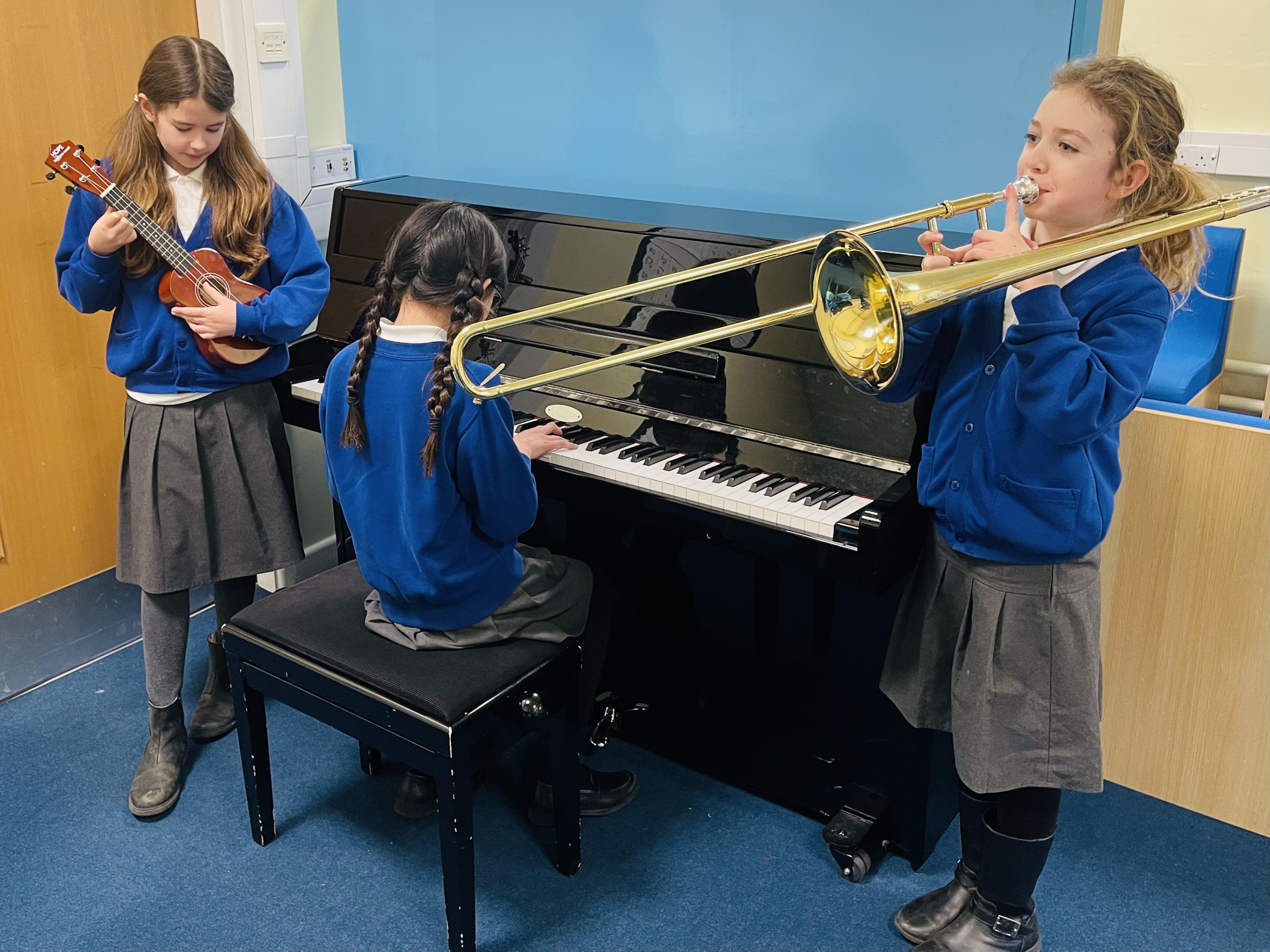
The music curriculum ensures children sing, listen, play, perform and evaluate. This is embedded in the classroom through the structured 'Charanga' scheme of music as well as the weekly singing assemblies and various partnership concerts/performances. The elements of music are taught in classroom lessons so that children can use some of the language of music to dissect it and understand how it is made, played, appreciated and analysed. In the classroom, children learn key aspects of music through cross-curricular links. They also learn how to compose, focusing on different dimensions of music, which in turn feeds their understanding when listening, playing, or analysing music. Composing or performing using body percussion and vocal sounds is also part of the curriculum, which develops the understanding of musical elements without the added complexity of an instrument.
How the Scheme is structured
Each Unit of Work comprises the strands of musical learning which correspond with the national curriculum for music:
1. Listening and Appraising
2. Musical Activities
- Warm-up Games
- Optional Flexible Games
- Singing
- Playing instruments
- Improvisation
- Composition
3. Performing
Mastery in Music Lessons
Charanga Musical School Units of Work enable children to understand musical concepts through a repetition-based approach to learning. Learning about the same musical concept through different musical activities enables a more secure, deeper learning and mastery of musical skills.
This allows for an opportunity to embed deeper learning, knowledge, understanding and skills. Musical teaching and learning is not neat or linear. The strands of musical learning, presented within the lesson plans and the on-screen resources, are part of the learning spiral. Over time, children can both develop new musical skills and concepts, and re-visit established musical skills and concepts. Repeating a musical skill doesn’t necessarily mean their progress is slowing down or their development is moving backwards! It's just shifting within the spiral. Mastery means both a deeper understanding of musical skills and concepts and learning something new.
Impact
The impact of the Music Curriculum at Leafield C.E. Primary School can be seen through:
- our children are engaged in and are excited by our music curriculum. The skills that they are taught equip them with a range of skills to enable them to appreciate music throughout their lives;
- our children becoming confident performers, composers, and listeners, who are able to express themselves musically at school and beyond;
- our children showing an appreciation and respect for a range of music from a variety of genres across a variety of generations;
- our children demonstrating and expressing their enthusiasm for music;
- our children progress through the Music Curriculum, which enables them to meet the expectations outlined at the end of each key stage of the National Curriculum.
See below for Leafield C.E. Primary's Music Development Plan.